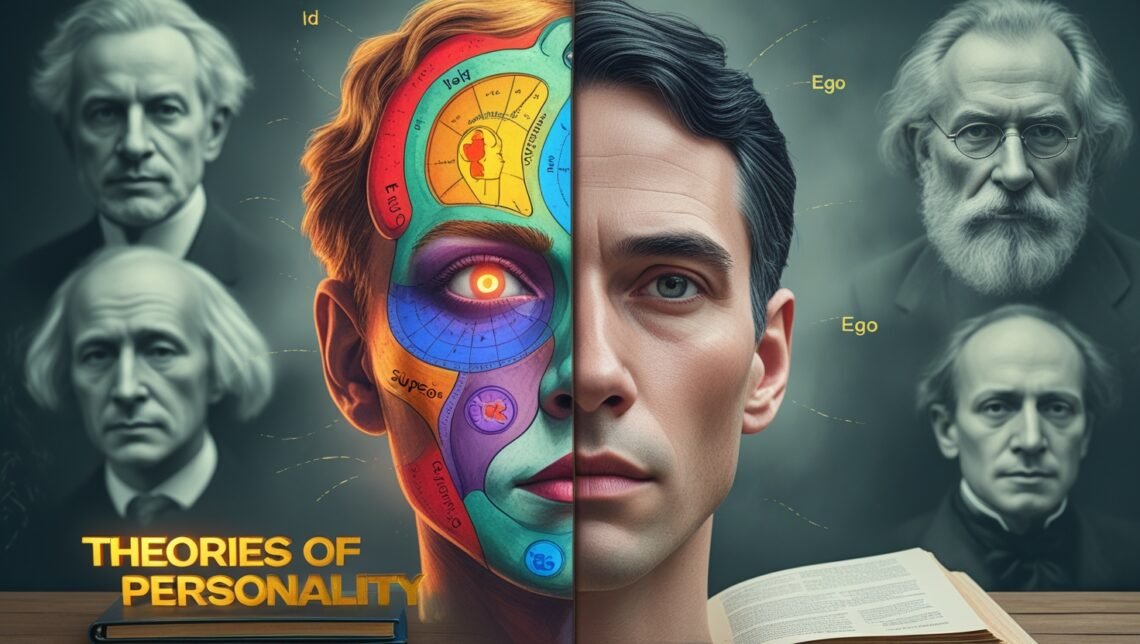
Every person has their unique personality, and someone’s nature is very calm, so some people are energetic every time, while some people are shy, and some are the soul of the life of every gathering. These differences have inspired us to think. After all, why do all these traits develop? The work of Personality theories is to explain how a person’s thoughts, behavior, and emotions are formed. Various scientists in Psychology have presented their theories, whose aim was to understand the human personality in a better way.
This blog will give you an easy and clear overview of those theories. We will see what Freud’s psychoanalytic theory says, what trait theorists believe, what the focus of humanistic psychologists is, and how the approach of social-cognitive theorists differs. Every theory has its logic, its explanation, and its approach. Understanding these theories not only gives others a chance to understand better, but it also gives them a chance to explore them deeply. Let’s start this journey to understand the deeper secrets of personality.
2. The Psychoanalytic Theory – Freud’s View:
Sigmund Freud developed a key theory to understand personality which is called Psychoanalytic Theory. According to Freud personality is divided into three parts: Id, Ego, and Superego. Id represents our unconscious desires and instincts – which want immediate satisfaction. Ego is the part which understands reality and maintains a balance between Id and Superego. The superego monitors moral values and rules of society.
Freud said that a large part of our personality is in the unconscious mind, where our repressed feelings and memories are stored. These unconscious factors silently affect our behavior.
Freud also highlighted that childhood experiences, such as early conflicts or trauma, deeply affect our emotional responses and relationships in the future. If there is any emotional disturbance in childhood, it can result in psychological issues in the adult personality.
Psychoanalytic theory helps us understand our inner conflicts, suppressed feelings, and unconscious motivations, which is useful in self-healing and therapy.
3. The Trait Theory – Focus of Personality Traits:
Trait Theory is used to measure personality. This theory states that every human being has some specific characteristics or traits that define their behavior. The most popular model of this theory is the Big Five Model (OCEAN). According to this model, personality is made up of five basic traits:
Openness – being ready for new experiences, being creative and curious
Conscientiousness – being disciplined and organized
Extraversion – being outgoing and energetic
Agreeableness – being kind, cooperative, and trusting
Neuroticism – level of emotional stability or instability
These traits explain the everyday behavior of a human being. For example, highly conscientious people are more responsible and dependable.
The advantage of trait theory is that it provides a scientific and measurable approach. Today’s personality tests, such as MBTI or Big Five Inventories, are based on this basis through which people can understand their strong and weak areas and plan their career, relationships, and personal goals better.
4. The Humanistic Theory – Emphasis on Self and Growth:
Humanistic theory is an optimistic view that focuses on human growth and potential. Two names of this theory are Carl Rogers and Abraham Maslow. Rogers gave ideas like “self-concept” and “unconditional positive regard”. He said that every person has a natural tendency for self-improvement, but this is possible only when they get acceptance and love from the environment.
Maslow introduced his famous Hierarchy of Needs model, in which he said that human needs are at different levels – physiological needs are at the bottom, and self-actualization is at the top. Self-actualization means achieving your full potential – becoming the best version of yourself.
According to Humanistic theory, personality development depends on positive experiences, freedom and personal responsibility. This theory gives importance to individuality and inner feelings.
Today, positive psychology is an extension of this theory in which work is done on people’s strengths, wellbeing and mental growth. The Humanistic approach encourages us to set our own goals, appreciate our uniqueness and grow through self-love.
5. The Social-Cognitive Theory – The Effect of Learning and Environment:
The pioneer of Social-Cognitive Theory is Albert Bandura, who gave the concept of “Social Learning” to explain personality. According to Bandura, people learn not only through direct experience but also through observational learning. We learn by observing the actions of others and adjusting our behavior.
Bandura gave another important concept which is called self-efficacy. It means your confidence in yourself that you can successfully complete a task. People who have high self-efficacy are not afraid of challenges and have more resilience.
The focus of this theory is how environment, thinking patterns and learning together shape personality. This theory states that personality is not a fixed thing, but keeps changing with life experiences and surroundings.
In today’s modern psychology, this theory is also used in behavioral therapy and education systems. It helps us to understand which people and situations influence us and how we can improve our learning patterns.
6. Conclusion:
Each personality theory explains human behavior from a unique angle. Freud’s psychoanalytic theory emphasizes the unconscious mind and inner conflicts, while trait theory scientifically measures who we are. Humanistic theory guides us to accept ourselves and grow, and social-cognitive theory explains how we develop through the environment and learning.
Understanding these theories not only provides academic knowledge, but also boosts self-awareness. When we know our strengths, weaknesses and motivations, we can make better decisions in our personal and professional life.
Ultimately, the best way to understand personality is to combine different theories. Every theory has its role, and all together give us a complete picture – a picture in which we can see ourselves in a better way and can progress in life.
FAQS:
- What is the main purpose of personality theories?
Personality theories aim to explain how a person’s thoughts, emotions, and behaviors are formed and why people behave differently. These theories help in understanding human nature and improving self-awareness and relationships.
- What are the key elements of Freud’s Psychoanalytic Theory?
Freud’s theory divides personality into three parts: the Id (instincts), the Ego (reality), and the Superego (morality). It emphasizes the unconscious mind and how childhood experiences affect adult personality and emotional behavior.
- What does Trait Theory say about personality?
Trait Theory explains personality through consistent traits. The Big Five Model (OCEAN) includes Openness, Conscientiousness, Extraversion, Agreeableness, and Neuroticism. It offers a scientific way to measure personality and is widely used in career and personal development.
- How does Humanistic Theory view personality development?
Humanistic Theory focuses on personal growth, self-acceptance, and the drive to reach full potential. It highlights concepts like self-concept, self-actualization, and the importance of a positive environment for mental and emotional development.
- What is the Social-Cognitive Theory of personality?
Social-Cognitive Theory, developed by Albert Bandura, explains personality through learning, observation, and environment. It introduces the idea of self-efficacy and states that personality changes with life experiences and surroundings.