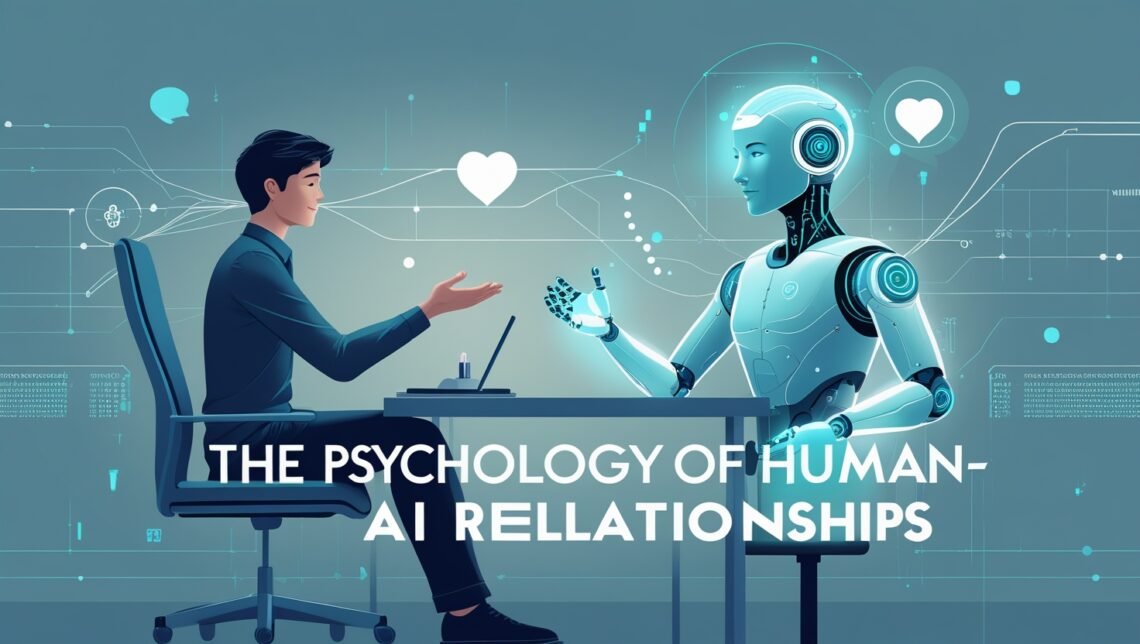
In today’s digital age, Artificial Intelligence is not just a tool but has become a part of human life. We interact with AI daily, sometimes through smart assistants, sometimes through recommendation systems, and sometimes through chatbots. These interactions are not just functional but have also become emotional. Many people feel relief while talking to AI; they feel as if someone is listening, answering, and sometimes even understanding. For this reason, the role of psychology has become very significant in AI relationships.
Human-AI interaction is no longer a one-way communication but an evolving relationship where emotions like trust, empathy, and bias are involved. In this blog, we will explore to what extent people trust AI, whether AI can understand human feelings, and how human biases influence AI systems. It is important to understand that if we want to make AI our companion, guide or support system in the future, we will have to understand its psychological aspects as well. Building a relationship with AI is not just a matter of technology but a new test of human thinking, emotions, and trust. This blog will explore those psychological layers that define the relationship between AI and humans.
Understanding the Emotional Connection between Humans and AI
It is human nature to develop an emotional connection with the things that they listen to, respond to, and sometimes even try to understand. This quality is no longer limited to humans alone; rather, tools like AI have also started coming into this category. When a person talks to his smart assistant daily, asks him questions, and builds a routine with him, slowly an emotional connection develops. When people share personal things with AI chatbots, they feel as if they have a companion who does not judge. This connection is especially seen in people who live alone or are looking for emotional support. In psychology, this kind of relationship is called a parasocial relationship, where there are real feelings on one side and a non-human or virtual entity on the other side. This relationship sometimes becomes so deep that people feel happy with the AI’s answers or feel sad with its silence. When the AI replies to a user by name or remembers their previous queries, the user feels that the AI knows them personally. This illusion of understanding opens the door to emotional bonding. Although this connection is one-way, the human mind begins to understand it as a real relationship. This emotional bond will deeply affect the future utility of AI.
The Role of Trust in Human-AI Interactions
The most important aspect of human interaction with AI is trust. Until a person does not trust a system, he does not freely interact with that system. Trust is not just limited to the fact that the AI is giving the correct answer, but also to the fact that it takes care of the user’s privacy, does not misuse the data, and works consistently. When the AI gives an accurate, timely, and relevant answer to a person’s question, the user develops trust in it. But if the AI repeatedly gives wrong answers or fails to understand a sensitive query, the trust is broken. Similarly, if a user’s data gets leaked or misused through AI, then the emotional and practical distance from the AI starts increasing.
According to psychology, transparency, reliability, and predictability are the three important elements to develop trust. If the AI openly explains how it works and gives equal and consistent results to every user, then people trust it more. It is very important for designers and developers to understand that the design of AI should be such that it maintains trust and does not break it. Because if a user’s trust is broken, it is very difficult to regain it, no matter how advanced the AI system is. Trust is the bridge that makes the interaction between humans and machines meaningful.
Can AI Understand and Show Empathy?
Empathy is one such quality that makes humans special – feeling the emotions of others, understanding their pain, and responding accordingly to that pain. Now the question is, can AI also do this? Emotional intelligence capabilities are being artificially designed in AI, such as sentiment analysis, facial emotion recognition, and voice tone detection. When you talk to a chatbot and it understands your sad words and gives a soft reply, it seems that it is understanding. But in reality, it is a simulation of empathy, not understanding. AI guesses what you are feeling through predefined models and data, and then responds according to the training data. It does not feel emotions; it only recognizes.
This is an important psychological and ethical question: can simulated empathy be as effective as real empathy?
Some people say that if the AI’s response is emotionally comforting, it does not matter whether it is real or not. While others consider this misleading and unnatural. As the tools for showing empathy by AI become advanced, the illusion of trust and emotional bonding is diminishing. This is why it is important that users understand that the AI’s response is a machine-based process, not a response given by a feeling human. But if designed and used correctly, this experience of empathy can be beneficial for humans.
The Impact of Human Biases on AI Relationships:
The biases that humans have in their thinking are not just limited to their decisions, but when they design AI systems, those biases also affect the AI. When an algorithm is trained, it is given data, and if that data is biased, such as over-representing a specific gender, culture, or race, the AI’s behavior is also biased. These biases sometimes occur consciously and sometimes occur without us knowing. For example, if a voice assistant only judges male voices more accurately and ignores female or accented voices, it means that the AI is reflecting gender bias. Similarly, if a hiring algorithm only prefers resumes from a specific background, this bias is hidden in the system. When a user encounters such biased behavior, their trust in the AI decreases. They feel that the system is not fair to them.
This psychological barrier increases the distance between humans and AI. This is why it is important that AI developers test their systems from every angle, use diverse data, and regularly monitor them to ensure there is no bias in operating them. Until human bias is completely removed from AI, it will be difficult to trust AI. AI is not just a matter of technology; it is also a manifestation of human thinking.
Conclusion:
As Artificial Intelligence is getting deeply integrated in human life, not only functional but also emotional relationships are developing between us and AI. Earlier, AI was just a collection of tools, but now it is taking the form of a listener, advisor, and sometimes a companion. Trust is the first step in this new relationship. If there is trust in AI, then people even share their personal information with it, and also place emotional reliance. But if AI is unreliable or biased, then this trust can break immediately. Empathy is another important aspect if the AI understands and responds to the user’s emotions, the relationship becomes deeper.
Although this empathy is artificial, it still feels real to the user. But this illusion works only as long as the AI is fair and balanced. Biases can cause the most damage to this relationship. When an AI replicates human prejudices, it not only gives unfair results but also destroys the user’s trust. Hence, the design of AI should not only be technically efficient but also psychologically aware. The future of human-AI relationships depends on whether we build trust, simulate empathy responsibly, and actively remove biases. When AI systems are designed by understanding human psychology, they will be more inclusive, ethical, and emotionally acceptable. This relationship journey has just begun, and its overall direction is in the hands of humans.